The world of trading card games has never been more exciting. Whether you’re collecting Pokémon, Magic: The Gathering, Yu-Gi-Oh!, Disney Lorcana, or the latest competitive card game, one question keeps coming up: should you buy a booster box or stick with individual booster packs? It seems like a simple decision until you start comparing prices, pull rates, resale potential, and long-term value. Suddenly, what looked like a straightforward purchase becomes a strategic investment.
Today’s trading card market is also very different from what it was only a few years ago. Limited print runs, surging collector demand, influencer-driven openings, and fluctuating secondary market prices have changed how collectors evaluate sealed products. Industry analysts continue to report that sealed products remain one of the strongest segments of the collectible hobby, although rising prices have made buyers increasingly selective about where they spend their money.
If you’ve ever stood in a hobby store wondering whether to grab one pack or commit to an entire booster box, you’re in exactly the right place. This guide breaks down every important factor—from pricing and probabilities to collecting strategies—so you can confidently choose the option that delivers the best value for your budget and collecting goals.
Understanding the Basics
Before comparing value, it’s important to understand exactly what each product offers. Many new collectors assume that a booster box is simply a larger version of a booster pack. While that is technically true, the buying experience and overall value are very different.
What Is a Booster Pack?
A booster pack is the smallest sealed product available for most trading card games. Depending on the game, each pack contains a fixed number of randomly assorted cards, including commons, uncommons, rares, and occasionally ultra-rare or special insert cards. Buying a single booster pack is similar to purchasing one lottery ticket. The excitement comes from not knowing what you’ll open, and every pack has the potential to contain something extraordinary.
Single packs appeal to casual collectors because they require very little upfront investment. Instead of spending well over one hundred dollars, someone can experience the thrill of opening fresh cards for only a few dollars. That accessibility explains why booster packs remain the entry point for most newcomers to the hobby.
There are additional advantages. Booster packs are easier to find in supermarkets, game stores, convenience shops, and online retailers. They also make excellent gifts because they’re inexpensive while still delivering excitement. Children, first-time collectors, and players who only need a handful of cards often find booster packs to be the most practical purchase.
There are drawbacks, though. Buying individual packs almost always results in paying a higher price per pack than purchasing a sealed box. Some secondary-market loose packs can also come with added risk if purchased from unknown sellers, particularly in hobbies where concerns over pack weighing, box mapping, or tampering exist. Buying from trusted retailers is always recommended.
What Is a Booster Box?
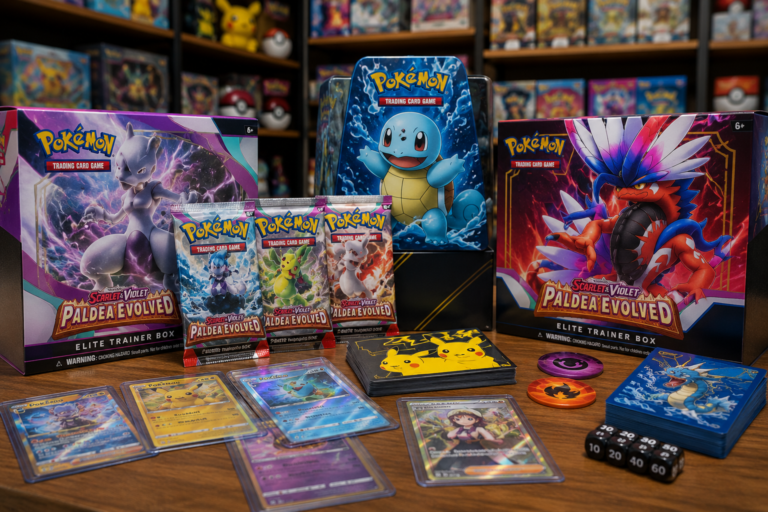
A booster box is a factory-sealed display containing multiple booster packs. Depending on the trading card game, a standard booster box usually contains between 24 and 36 packs, although some products differ. The cards inside remain random, but purchasing them together dramatically changes the economics.
Think of a booster box as buying in bulk at a wholesale club. You’re spending significantly more money upfront, yet every individual unit costs less. That same principle applies to trading cards. Rather than paying retail price for dozens of individual packs, manufacturers and retailers typically discount the overall price when those packs are purchased together.
Another important advantage is convenience. Instead of hunting for packs across multiple stores, collectors receive an entire display ready for opening, drafting, or storing as a sealed collectible. Competitive players often buy booster boxes because they need a large number of cards from a new expansion to build decks quickly. Collectors appreciate them because they maximize opportunities to pull desirable cards while minimizing cost per pack.
Perhaps most importantly, sealed booster boxes themselves have become collectible assets. Vintage sealed boxes from popular expansions frequently command substantial premiums years after release because many collectors prefer unopened products with guaranteed authenticity. Although future appreciation is never guaranteed, sealed boxes generally hold greater long-term collector appeal than loose packs.
How Trading Card Products Have Changed in 2026
The trading card hobby has evolved rapidly over the last several years. What was once considered a niche pastime has grown into a global collectibles industry worth billions of dollars, attracting everyone from casual fans to serious investors. Social media platforms have accelerated this trend by making pack openings, live breaks, and rare card discoveries accessible to millions of viewers every day.
Manufacturers have responded by releasing more premium products, special editions, and limited-print collectibles than ever before. New expansions often sell out quickly, especially for popular franchises such as Pokémon and Disney Lorcana. Limited supply combined with high demand has pushed many products above their original retail price almost immediately after release.
These market dynamics have also made buyers much more value-conscious. Instead of simply asking, “Can I afford this?” collectors increasingly ask, “Which product gives me the lowest cost per pack?” Recent market comparisons consistently show that standard booster boxes usually provide the best value on a cost-per-pack basis for actively printed sets. Current guides place many standard booster boxes at roughly $3.60–$4.40 per pack, while buying comparable products individually often costs noticeably more.
That said, value is no longer determined by mathematics alone. Experienced collectors also evaluate scarcity, print runs, exclusive promotional cards, future resale potential, storage, and even how enjoyable the opening experience will be. Someone interested in completing a master set may prioritize maximum pack volume, while another collector focused on long-term investing might never open the box at all.
Understanding your personal objective is the key to making the smartest purchase. A booster box can be the better financial value while still being the wrong choice for someone who simply wants a few packs to enjoy on a weekend.
Cost Comparison: Where the Real Savings Begin
If the discussion stopped at simple arithmetic, the winner would be obvious. Booster boxes almost always provide a lower cost per booster pack than buying the same number of individual packs separately. Manufacturers intentionally price sealed boxes this way because bulk purchases encourage larger sales while rewarding committed collectors.
The following table illustrates a typical comparison seen across many modern trading card games.
| Purchase Option |
Typical Packs |
Approximate Price |
Average Cost Per Pack |
| Single Booster Pack |
1 |
$5–$7 |
$5–$7 |
| Booster Box |
24–36 |
$120–$180 |
$3.75–$5.00 |
Recent market analyses continue to support this pattern. For many standard releases, booster boxes consistently offer the lowest average cost per pack, making them the preferred option for collectors planning to open large quantities of cards. Individual pack pricing remains attractive for buyers with smaller budgets, but purchasing enough loose packs to equal a full box almost always costs more overall.
The savings become increasingly noticeable as the number of packs increases. Imagine purchasing thirty-six individual booster packs at retail pricing. Even a difference of one or two dollars per pack quickly adds up, potentially costing fifty dollars or more compared to buying a sealed booster box. That extra money could instead be used toward protective sleeves, deck boxes, grading submissions, or even another expansion.
The financial advantage, however, comes with one important trade-off: the initial investment. Spending over one hundred dollars in a single purchase isn’t realistic for everyone. Casual collectors may actually obtain better personal value by buying a few booster packs each month rather than stretching their budget for an entire box.

Does Buying a Booster Box Improve Your Odds?
One of the biggest myths in the trading card community is that purchasing a booster box guarantees better cards. The reality is a little more nuanced. Every booster pack is independently randomized during production, meaning there is no promise that a specific rare card will appear simply because you purchased an entire box. Manufacturers design their products so that every pack has its own probability of containing rare, ultra-rare, or chase cards.
What a booster box does improve is your overall statistical opportunity. Think of it like flipping a coin. Flipping a coin once gives you a 50% chance of heads, but flipping it 36 times makes it far more likely you’ll see multiple heads simply because you’ve increased the number of attempts. The same principle applies to trading cards. More packs mean more opportunities to pull high-value cards, alternate-art cards, secret rares, serialized cards (where applicable), or other premium inserts.
Many modern trading card games also display relatively consistent rarity distributions across factory-sealed boxes, although manufacturers generally avoid guaranteeing exact contents. Experienced collectors often report more predictable results from sealed booster boxes than from buying the same number of loose packs from different retailers. That consistency doesn’t eliminate randomness, but it does reduce some of the uncertainty associated with individual purchases.
The most important takeaway is that buying a booster box does not increase the odds of any single pack containing a rare card. Instead, it increases the total number of chances you have to open desirable cards while lowering your average cost per attempt. If your goal is maximizing opportunities rather than chasing certainty, a booster box usually delivers better overall value.
Understanding Random Distribution
Random distribution is the foundation of every trading card game. Manufacturers carefully engineer print runs so that no customer can predict exactly what will appear inside a sealed product. This randomness keeps collecting exciting and helps maintain the value of rare cards in the secondary market.
Collectors sometimes experience what feels like extraordinary luck—or incredibly poor luck. One player might pull several premium cards from only a handful of booster packs, while another could open an entire booster box without finding the specific chase card they wanted. Both outcomes are perfectly normal because probability does not guarantee individual results.
That uncertainty is exactly what makes opening trading cards so entertaining. Every sealed pack represents possibility. Every booster box represents dozens of opportunities. Understanding the mathematics behind randomness helps buyers make smarter financial decisions rather than relying on anecdotes from social media or spectacular pack-opening videos.

Best Situations for Single Packs
Despite offering a higher cost per pack, booster packs remain an excellent choice for many collectors. Value is not determined solely by price. Sometimes flexibility, convenience, and affordability matter far more than maximizing long-term savings.
Single booster packs are ideal for beginners who want to explore a new trading card game without committing to a large purchase. Spending five or six dollars to learn the mechanics, artwork, and card quality is far less intimidating than investing well over one hundred dollars in a full booster box. Parents shopping for children also appreciate this accessibility because booster packs make inexpensive rewards, birthday gifts, or stocking fillers.
Casual collectors benefit as well. If you enjoy opening a few packs every couple of weeks simply for entertainment, buying individual packs prevents unnecessary spending while still providing the excitement of discovering new cards. Many players who primarily purchase singles for competitive deck building also buy occasional booster packs purely for enjoyment rather than expectation.
Another advantage is flexibility. A collector can sample multiple expansions instead of committing to one set. Rather than buying a single booster box, the same budget could purchase packs from several different releases, providing a more diverse collecting experience.
Best Situations for Booster Boxes
Booster boxes are generally the preferred option for serious collectors, competitive players, content creators, and anyone planning to open a substantial number of packs from a single expansion. The financial advantages become increasingly clear as the number of packs increases.
Collectors attempting to complete a master set naturally require large volumes of cards. Purchasing an entire booster box lowers the average acquisition cost while significantly expanding the collection in a single opening session. Competitive players also benefit because they gain access to a wide variety of cards immediately after a new release, making deck construction faster and often less expensive than buying numerous loose packs.
Content creators frequently choose booster boxes because viewers enjoy longer opening videos with more dramatic pulls. A single box creates anticipation, suspense, and a complete opening experience that individual packs rarely match.
Perhaps the strongest argument for booster boxes is long-term collecting. Sealed products often become increasingly desirable after print runs end, especially for successful expansions. While appreciation is never guaranteed and should not be viewed as a risk-free investment, unopened booster boxes generally retain stronger collector demand than loose packs because buyers value factory seals, authenticity, and completeness.
Long-Term Collecting
The investment side of trading card games has received enormous attention during the past decade. Record-breaking auction sales, celebrity collectors, and growing international demand have encouraged many hobbyists to view sealed products as long-term collectibles rather than simply items to open.
Booster boxes occupy a unique position in this market. Unlike individual cards, sealed boxes preserve every possibility inside them. Buyers are purchasing potential as much as physical cards. Years after a product leaves print, collectors often pay significant premiums for unopened boxes because they can no longer obtain factory-fresh packs through normal retail channels.
Storage also plays an important role. Keeping a booster box sealed, protected from sunlight, humidity, and physical damage helps preserve its condition. Collectors frequently use acrylic display cases or secure storage containers to minimize wear over time. Proper storage does not guarantee future appreciation, but it helps maintain resale value should market demand increase.
Investing should still be approached carefully. Trading card markets can fluctuate based on print runs, player interest, tournament popularity, licensing decisions, and broader economic conditions. Purchasing products because you genuinely enjoy collecting them is generally a healthier strategy than relying solely on future price appreciation.

Final Verdict
Choosing between a booster box and booster packs ultimately depends on what “value” means to you.
If your objective is obtaining the lowest cost per pack, building a large collection efficiently, maximizing opening opportunities, or potentially holding sealed products for the future, a booster box is almost always the stronger financial decision.
If your priorities are affordability, flexibility, casual enjoyment, or trying multiple expansions without a large upfront investment, booster packs remain an excellent option despite their higher individual price.
The smartest collectors understand that neither product is universally better. Each serves a different purpose. Someone building tournament decks may benefit enormously from booster boxes, while someone opening a pack every Friday simply for fun may receive far greater personal satisfaction from individual purchases.
Instead of asking which product is objectively superior, ask yourself one simple question:
What am I trying to accomplish with this purchase?
The answer almost always reveals which option provides the greatest value.
The debate between booster boxes and booster packs has existed for years, yet the answer remains surprisingly straightforward once the numbers and objectives are examined together. Booster boxes consistently provide the best value from a mathematical standpoint because they reduce the average cost per pack while offering more opportunities to discover valuable cards. They also appeal to collectors interested in completing sets or preserving sealed products for the future.
Booster packs, however, continue to play an important role within the hobby. They make trading card games accessible to beginners, allow collectors to control spending, and preserve the excitement of opening random cards without requiring a significant financial commitment. For many enthusiasts, the enjoyment of occasionally opening a few packs outweighs the savings associated with purchasing an entire box.
Ultimately, the best purchase is the one that aligns with your goals, budget, and collecting style. Whether you’re chasing rare cards, building competitive decks, investing in sealed products, or simply enjoying the thrill of opening packs with friends, understanding the strengths of each option ensures every dollar spent delivers the greatest possible value.
Frequently Asked Questions